
Shopify Plus Migration Case Study: Zero-Downtime Replatforming for Robert Abbey Lighting
Robert Abbey, Inc.

Shopify Plus Migration Case Study: Zero-Downtime Replatforming for Robert Abbey Lighting
Introduction
A Shopify Plus migration case study is more than a story about moving from one platform to another. It is a strategic record of how a business upgraded its commercial infrastructure, reduced operational friction, improved customer experience, and created a stronger foundation for growth.
For Robert Abbey Lighting, the migration was about exactly that. The business had built a respected brand around design, craftsmanship, and a broad lighting catalog, but its digital platform was no longer aligned with the complexity of its operations or the expectations of modern buyers. The company needed an ecommerce environment that could better express its brand, support wholesale relationships, handle extensive product complexity, and do so without introducing unacceptable risk during transition.
A zero-downtime Shopify Plus migration means replacing the existing ecommerce platform while preserving business continuity across catalog operations, customer access, and active order workflows. In Robert Abbey’s case, that requirement was essential. The project had to protect revenue, maintain trust with trade and wholesale customers, and ensure that the move to Shopify Plus strengthened the business without creating disruption during cutover.
MLVeda was selected to lead this transformation because the work demanded more than theme design or basic platform setup. It required a partner capable of combining commerce strategy, migration engineering, B2B implementation, and custom product experience development within a single, execution-ready roadmap. The result was a Shopify Plus solution designed not just to launch successfully, but to support Robert Abbey’s next stage of digital commerce growth.



Business Challenges: High-SKU B2B Lighting and Legacy Platform Limitations
Robert Abbey’s business model introduced a level of digital complexity that many standard ecommerce implementations are not equipped to handle well. The company needed to serve both retail and wholesale audiences, present a design-forward catalog at scale, and support product structures that extended beyond ordinary variant patterns. Its legacy platform was increasingly becoming a constraint rather than an enabler.
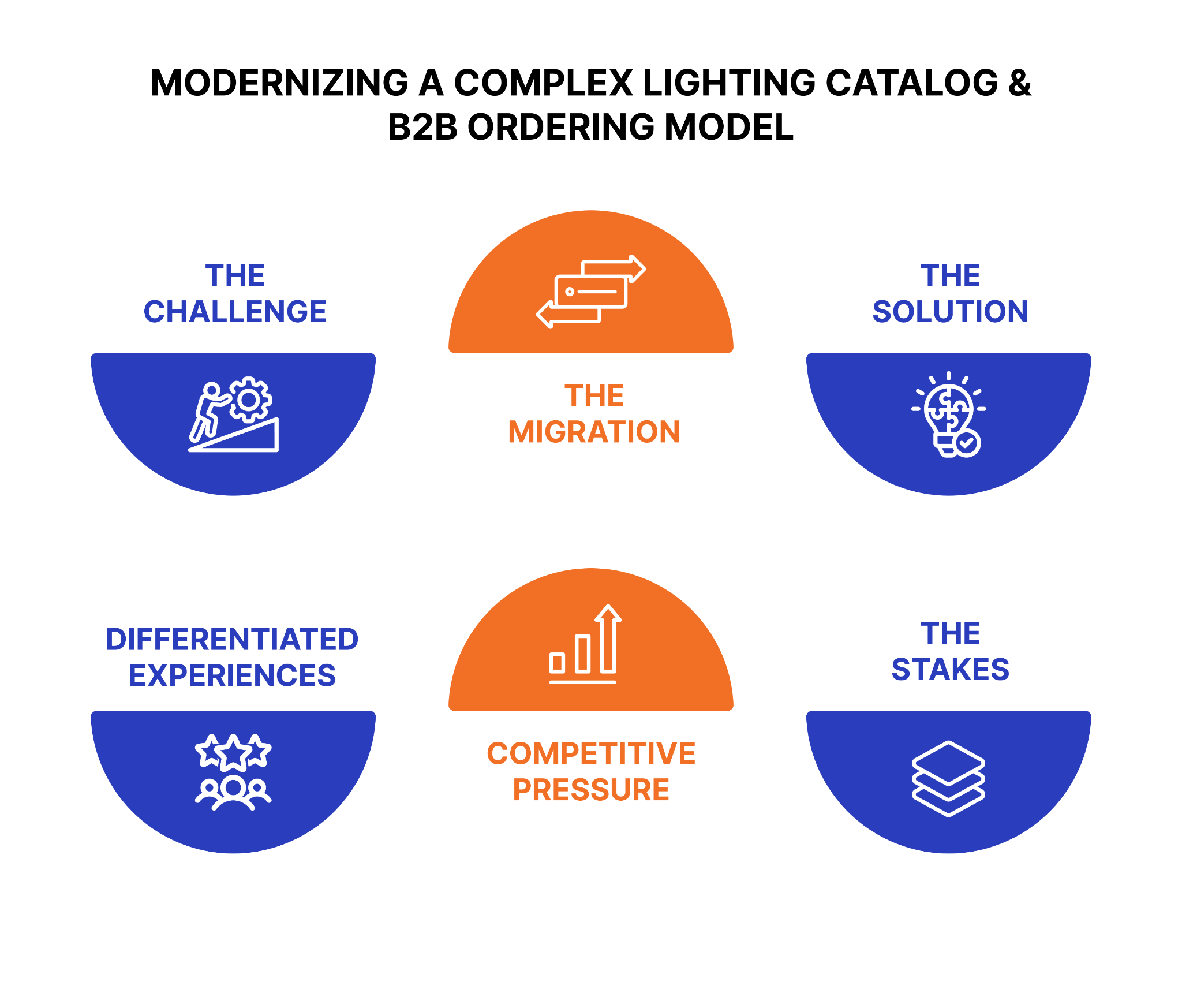
The first major issue was brand expression. Robert Abbey wanted a site experience aligned closely with its visual identity, but the previous platform environment made it difficult to deliver the level of design consistency and merchandising flexibility that a premium lighting brand requires. Home, product, and collection pages needed to feel more cohesive, more modern, and more reflective of the company’s market positioning.
The second challenge was B2B functionality. Robert Abbey needed different content visibility and pricing for logged-in wholesale customers. This included the ability to surface wholesale-specific pages and account-aware pricing logic in a way that felt native to the experience rather than patched together through operational workarounds. For a business serving professional buyers and trade relationships, this was not a nice-to-have capability. It was a core commercial requirement.
The third challenge was data and catalog scale. The migration involved more than 35,000 SKUs, over 5,000 customers, more than 400 companies, and upwards of 8,000 historical orders. That scope alone demanded disciplined migration planning, rigorous data mapping, and high confidence in validation. A poorly executed migration would not only create technical issues. It would directly affect the continuity of customer relationships and back-office operations.
The fourth challenge was product complexity. Robert Abbey needed to display more than 5,000 variants for a single product, which introduces a problem because Shopify’s standard variant model is not built to accommodate that requirement directly in a single product object. This meant the solution had to preserve the customer-facing simplicity of a single product while introducing a custom architectural pattern behind the scenes.
The fifth challenge centered on the table lamp builder. Robert Abbey wanted customers to be able to mix and match tops, middles, and bases without having to create every possible image combination manually. This was both a customer experience challenge and a content operations challenge. Without the right solution, the builder would either become visually limited for customers or operationally unsustainable for the merchandising team.
Taken together, these issues made it clear that the project was not just a platform migration. It was a business-critical modernization initiative where architecture, user experience, and operational design had to work together from day one.
Solution Architecture: Shopify Plus for B2B Lighting Ecommerce
MLVeda approached the engagement with a solution architecture designed to reduce migration risk while increasing long-term platform flexibility. The implementation was built on Shopify Plus as the core commerce platform, supported by custom development where Robert Abbey’s catalog and customer experience requirements extended beyond standard platform behavior.
The engagement began with design. Rather than treating the frontend as a post-migration cosmetic layer, the storefront experience was defined upfront in Figma, with dedicated designs for the home page, product pages, and collection pages. This ensured that the final Shopify Plus implementation reflected Robert Abbey’s brand identity from the beginning and gave all stakeholders a clear visual baseline before development moved into production.
The Shopify storefront itself was then developed against these approved designs. This created a direct link between design intent and implementation quality, which is especially important in premium retail categories where presentation influences both brand perception and conversion performance.
For wholesale and trade operations, the architecture used Shopify’s native B2B capabilities to manage differentiated customer experiences. Wholesale users could log in and see account-appropriate pages and pricing, enabling Robert Abbey to support distinct B2B workflows without forcing those requirements into an inflexible retail-first model. This was a strong fit for a business that needed to blend B2C brand presentation with B2B account logic.
The migration layer was handled through custom development using Node.js, enabling the transfer of products, customers, companies, and orders from the legacy platform into Shopify. This migration strategy was designed around accuracy, repeatability, and controlled cutover. Rather than relying on superficial data movement, the project treated data structure, field mapping, and validation as foundational to launch quality.
The most technically distinctive part of the architecture was how it handled product complexity. To represent more than 5,000 variants for a single product, MLVeda developed a custom solution in which multiple backend products were structured and managed as one unified product on the frontend. This allowed the customer to interact with the catalog in a natural way while allowing the system to work around platform limits in a maintainable way.
The lamp builder followed a similar principle. Instead of attempting to pre-render all image combinations, the system allowed customers to select a top, middle, and base and dynamically produce a combined image based on those selections. The backend process relied on componentized imagery provided by the merchant, making it possible to deliver a visually rich configurator without creating an unsustainable content burden.
This architecture gave Robert Abbey a platform that was not only launch-ready but also future-ready. Shopify Plus handled the core commerce layer, native B2B features supported trade operations, and MLVeda’s custom engineering addressed the product and presentation challenges that differentiate premium lighting commerce from more generic retail implementations.
Key Technical Components
The technical delivery combined native Shopify Plus capabilities with targeted custom development. This balance was important. It reduced unnecessary complexity where the platform was already strong while reserving custom engineering for the areas where Robert Abbey’s business requirements genuinely demanded it.
Several of these components are especially important from a strategic perspective. The B2B setup allowed Robert Abbey to preserve wholesale-specific commercial logic while simplifying the customer experience. The migration framework protected business continuity across a large and complex dataset. The high-variant display solution and lamp builder created functionality that would have been difficult to support elegantly without custom engineering.
These are not isolated feature decisions. Together, they shaped a commerce environment that can support scale, merchandising depth, and customer self-service more effectively than the previous platform.
Implementation Methodology
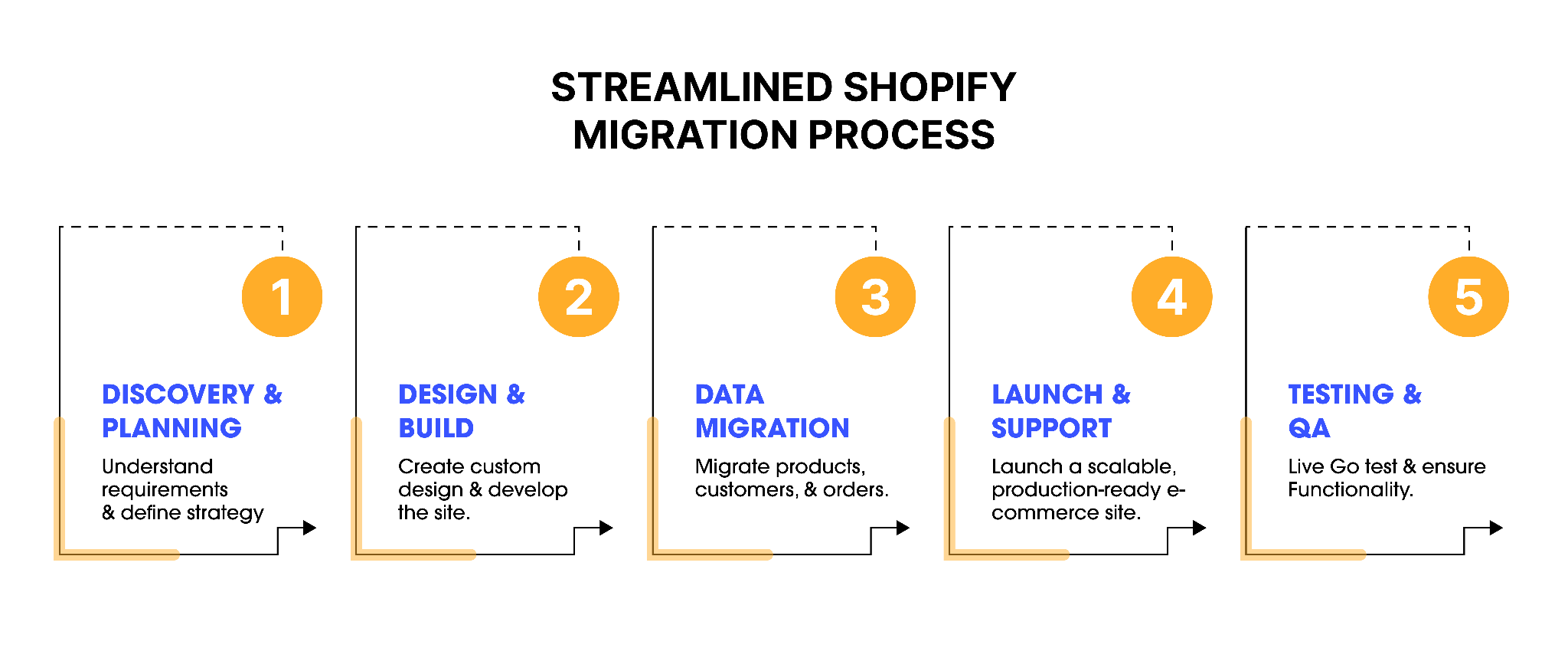
How to plan a Shopify Plus migration for high-SKU B2B brands depends on one principle above all others: the migration must be treated as an operational transformation, not just a web development project. Robert Abbey’s implementation reflected that reality. The program was structured to balance speed, risk control, data quality, and stakeholder confidence from planning through launch.
The first phase focused on requirements alignment and migration planning. This included understanding the current platform, defining which data entities had to move, identifying how B2B workflows should function in Shopify Plus, and translating business goals into implementation priorities. This early alignment reduced downstream rework and gave the project a strong operational footing.
The next phase centered on design and experience definition. By developing page concepts in Figma before theme implementation, the project ensured that brand presentation and UX logic were fully resolved before development accelerated. That decision also improved internal approval cycles because stakeholders could evaluate the future storefront visually and structurally before it existed in code.
Build and configuration then moved in parallel with migration preparation. This included theme development, B2B setup, shipping and payment configuration, and the custom logic required for high-variant product display and the lamp builder. Running these streams in parallel improved delivery efficiency while preserving dependency control.
Migration execution required careful trial runs and validation cycles. Because the project included product records, customer accounts, company relationships, and historical orders, the data work had to be tested and refined before go-live. Validation was not limited to whether records moved. It also had to confirm that those records behaved correctly inside the new Shopify Plus environment.
The final phase focused on launch readiness, cutover, and stabilization. A zero-downtime migration strategy meant that launch planning had to account for business continuity as much as technical deployment. The objective was not simply to make the new site live. It was to make it live without interrupting core customer and wholesale workflows.
A practical migration roadmap for a project of this complexity typically includes the following phases:
- Discovery and solution planning
- UX and visual design
- Shopify Plus build and configuration
- Data migration development and validation
- User acceptance testing and launch preparation
- Go-live, monitoring, and post-launch optimization
Table: Phased Delivery Approach
The strength of this methodology lies in its realism. Enterprise and mid-market migrations rarely fail because the platform is wrong. They fail because planning, data handling, stakeholder alignment, and risk management are treated as secondary concerns. In this project, those areas were treated as central to execution quality.
Quantified Business Results and Benchmark-Based ROI
What were the main results of the Robert Abbey Lighting Shopify Plus migration? The most important immediate result was structural rather than cosmetic: Robert Abbey moved from a limiting legacy platform to a more scalable commerce foundation capable of supporting high-SKU operations, wholesale-specific experiences, complex product presentation, and custom visual configuration. That foundation matters because it enables performance, operational efficiency, and future growth to compound over time.
Because specific post-launch commercial metrics are not being published, the most credible way to discuss quantified impact is through conservative industry benchmarks from similar Shopify Plus migrations. For companies with large catalogs, mixed B2B and B2C requirements, and meaningful UX improvement at launch, benchmark ranges often show measurable gains in conversion performance, merchandising efficiency, and time-to-value within the first year.
What is the ROI of a Shopify Plus migration for enterprise retail? The answer depends on traffic volume, internal process complexity, support costs, and the degree to which the legacy platform is constraining growth. In Robert Abbey’s case, ROI should be understood as a combination of commercial upside and operational savings. Revenue impact can come from improved conversion, higher average order value, and stronger B2B self-service. Operational returns can come from reduced maintenance burden, cleaner merchandising workflows, and lower dependency on workaround-heavy processes.
Equally important is risk reduction. A zero-downtime migration reduces the likelihood of revenue interruption during launch. A cleaner platform architecture lowers long-term maintenance drag. A more capable B2B setup helps preserve and strengthen trade relationships that might otherwise be strained by digital friction.
In that sense, the business case goes beyond a simple platform switch. It is the replacement of digital friction with digital leverage.
Strategic Best Practices and Executive Takeaways
Is Shopify Plus suitable for high-SKU B2B lighting brands? The answer is yes, provided the implementation is designed around the specific realities of the catalog and the customer model. Shopify Plus is a strong platform for businesses that need speed, extensibility, and manageable total cost of ownership, but projects of this kind still require thoughtful architecture where product complexity and wholesale logic exceed standard patterns.
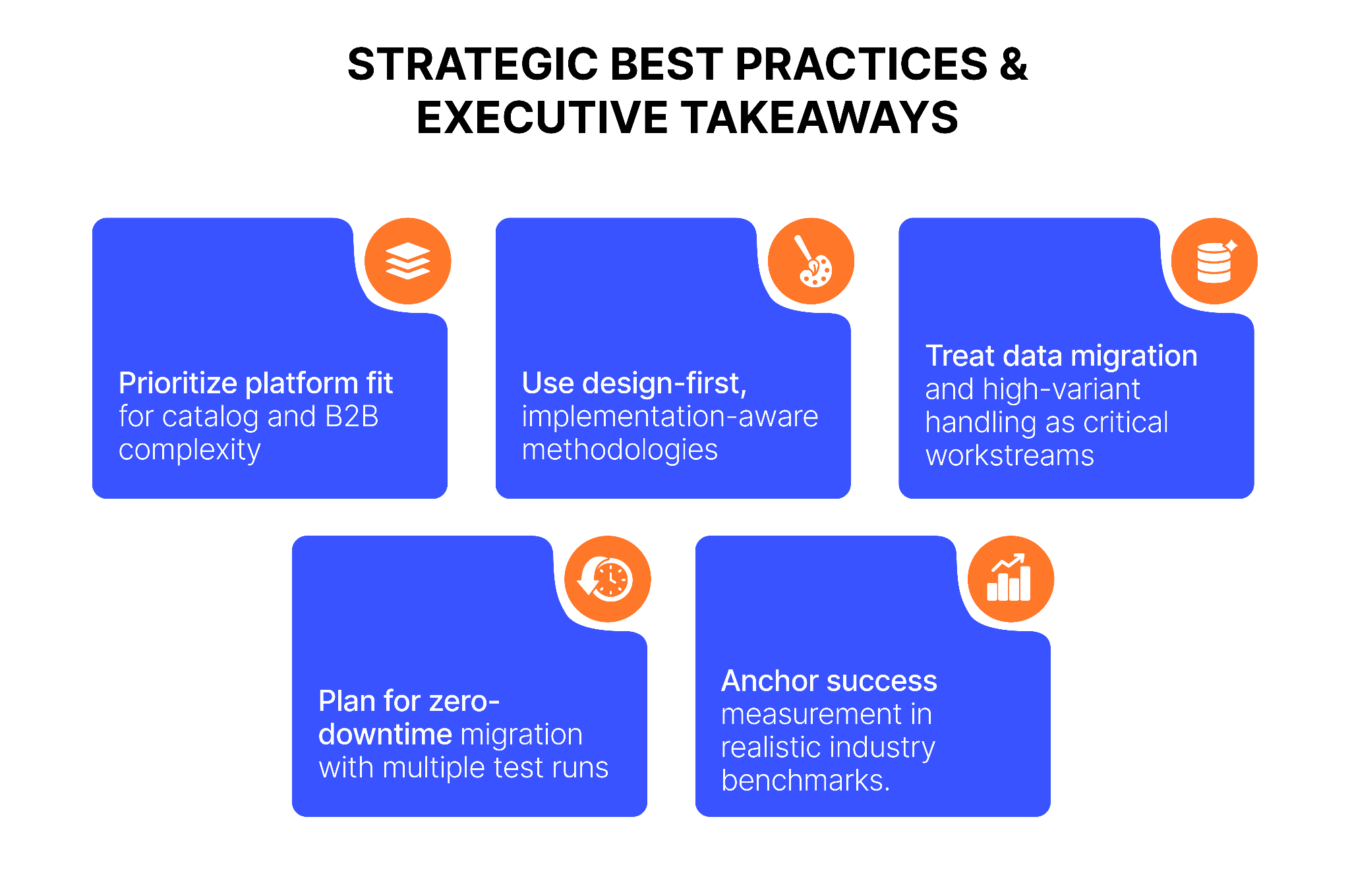
Robert Abbey’s implementation highlights several best practices that are highly transferable to similar brands. The first is to design for operational truth, not just launch aesthetics. A beautiful storefront is valuable, but it will not create durable value if data structures, account logic, or content workflows are not aligned with the business behind the screen.
The second is to use native platform capabilities wherever they are strong, and apply custom engineering selectively. This reduces complexity while still giving the business the flexibility it needs in differentiated areas. In this project, native B2B features, native commerce operations, and custom solutions for variants and configuration created the right balance.
The third is to treat migration quality as a leadership issue, not just a technical issue. Large catalog migrations, especially those involving historical customers, company relationships, and order data, can create downstream operational problems if they are handled casually. Strong governance, careful validation, and controlled launch sequencing are essential.
The fourth is to view product experience as a competitive asset. In categories like decorative lighting, where configuration and presentation influence both customer confidence and perceived value, tools like a visual builder can create meaningful differentiation when executed well.
A few executive takeaways stand out clearly:
- Migration strategy should be tied to business continuity, not just launch dates.
- B2B functionality should be integrated into the customer experience, not layered on as a workaround.
- Large-catalog brands need architecture that supports scale behind the scenes while keeping the frontend simple.
- Customization delivers the most value when reserved for true business differentiators.
- The right implementation partner is often the difference between a successful replatforming and an expensive reset.
A realistic evaluation framework for selecting a Shopify Plus migration partner should include technical depth, B2B implementation experience, migration governance, custom commerce engineering capability, and the ability to translate business goals into an execution model that internal teams can actually maintain after launch.
Section 8: Executive Conclusion
Robert Abbey Lighting’s move to Shopify Plus demonstrates what a successful modern ecommerce migration should look like when business priorities, technical execution, and risk management are aligned from the start. This was not a generic replatforming initiative. It was a carefully structured transformation designed to support a premium brand, a complex catalog, and a dual B2C-B2B customer model within a single scalable commerce ecosystem.
MLVeda’s role in the project went beyond implementation delivery. The engagement required strategic interpretation of the client’s needs, disciplined migration execution, custom architecture for high-variant products, and the creation of differentiated product experiences such as the lamp builder. Just as importantly, it required a zero-downtime approach that protected operational continuity throughout the transition.
For commerce and technology leaders evaluating their own migration path, the broader lesson is clear. The value of Shopify Plus is not just in its platform capabilities. It is in how those capabilities are applied to solve real operational and commercial constraints. When that is done well, the result is not simply a new storefront. It is a stronger business system.
For organizations considering a Shopify Plus migration, B2B ecommerce modernization, or custom product experience development, MLVeda offers the combination of strategy, engineering, and execution discipline required to deliver transformation with confidence.
FAQs
What were the main results of the Robert Abbey Lighting Shopify Plus migration?
The migration gave Robert Abbey a scalable Shopify Plus foundation capable of supporting a large product catalog, B2B wholesale workflows, custom product presentation, and a modernized brand experience. It also enabled a zero-downtime launch approach and created the basis for benchmark-aligned improvements in conversion, operational efficiency, and time-to-value.
How did MLVeda handle 35,000+ SKUs and 5,000+ variants per product on Shopify Plus?
The migration used custom engineering to move more than 35,000 SKUs and related customer, company, and order data from the legacy platform into Shopify. For products requiring more than 5,000 variants, multiple backend product records were structured and surfaced as a single unified frontend experience, allowing the catalog to remain intuitive for customers while staying technically maintainable.
Why is Shopify Plus a good fit for B2B lighting ecommerce brands?
Shopify Plus is a strong fit for B2B lighting ecommerce brands because it combines a modern commerce core with native B2B capabilities and a flexible ecosystem for extension. For brands with wholesale accounts, large catalogs, and product presentation complexity, it offers a balance of scalability, maintainability, and faster time-to-market compared with more cumbersome legacy environments.
How to migrate from a legacy ecommerce platform to Shopify Plus without downtime?
A zero-downtime Shopify Plus migration requires disciplined planning, staged build and validation, repeated data migration testing, and carefully managed cutover sequencing. The key is to treat the project as a business continuity program as much as a technology transition, ensuring that catalog data, customer access, and operational workflows remain stable through launch.
What is the ROI of a Shopify Plus migration for enterprise retail?
ROI typically comes from a combination of stronger conversion performance, improved customer experience, reduced operational inefficiency, lower maintenance overhead, and better support for growth. In comparable enterprise and mid-market migrations, conservative benchmarks often show payback beginning within 9 j to 12 months, depending on catalog scale, traffic, internal complexity, and post-launch optimization discipline.
We’re Listening
Whether you're exploring strategic transformation opportunities or seeking a partner to architect and execute enterprise technology initiatives, we're here to help. Reach out to our team at services@mlveda.com or complete the form to begin the conversation.

