
Candela Medical: Salesforce Commerce Cloud to Shopify Plus Transformation
Candela Medical

Candela Medical: Salesforce Commerce Cloud to Shopify Plus Transformation
Introduction
Executive Summary
Candela Medical consolidated four regional B2B storefronts from Salesforce Commerce Cloud into a single Shopify Plus instance to create a centralized commerce foundation for global expansion, simpler operations, and faster execution across markets.
The new platform unified catalog management, account-based pricing, order workflows, and localized buyer experiences while integrating tightly with Salesforce CRM, Oracle ERP, Vertex, MuleSoft, and Oracle Integration Cloud. Delivered over a four-month period from January 2026 to April 2026, the engagement replaced a fragmented regional operating model with a scalable, modular architecture built for international growth.
Phase 1 launched six core markets—United States, United Kingdom, Canada, Australia, New Zealand, and Internal Sales—and established a repeatable framework for future rollout across additional countries and distributor accounts. The result was a stronger digital commerce operating model with lower total cost of ownership, faster development cycles, and a durable platform for long-term B2B expansion.
Introduction
Candela Medical needed a modern commerce platform that could support global B2B operations without the cost and complexity of managing multiple independent regional storefronts. As a leading medical-aesthetic device company with an international footprint, Candela’s digital commerce environment had to serve multiple geographies, internal sales teams, customer service users, and future distributor channels while preserving localized pricing, tax handling, payment terms, and account-specific workflows.
The initiative was structured as an explicit Salesforce Commerce Cloud to Shopify Plus transformation rather than a simple storefront redesign. The objective was to unify four regional Salesforce Commerce Cloud storefronts into one centralized Shopify Plus environment that could maintain business continuity, reduce platform overhead, and support future global scale. Instead of recreating region-specific logic in a heavily customized way, the implementation used Shopify Plus native B2B and Markets capabilities to establish a cleaner operating model with less duplication and stronger governance.
The migration scope covered products, customers, companies, and historical orders, along with integrations into Salesforce CRM, Oracle ERP, and Vertex using MuleSoft and Oracle Integration Cloud. The engagement also included checkout customization, shipping configuration, product purchase eligibility logic, and real-time synchronization across systems. This allowed Candela to preserve critical business rules while simplifying the architecture that supports them.



Business Challenges
Candela’s legacy environment created a level of operational complexity that was increasingly difficult to sustain. Four separate B2B storefronts on Salesforce Commerce Cloud meant duplicated administration, fragmented workflows, inconsistent regional implementation patterns, and a higher support burden across internal teams. Every regional variation increased the cost of maintenance and made it harder to introduce change consistently.
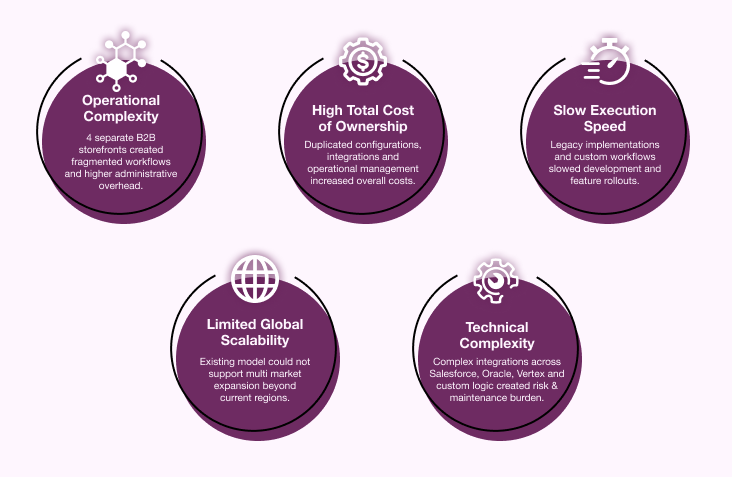
One of the clearest business pressures was total cost of ownership. Maintaining four Salesforce Commerce Cloud storefronts required overlapping configuration effort, duplicated integrations, and repeated operational management. Consolidation into a single Shopify Plus environment offered a more efficient model by centralizing core commerce operations while still preserving market-specific requirements.
Execution speed was another issue. Legacy Salesforce Commerce Cloud implementations and custom workflows slowed development cycles, made feature rollouts harder to coordinate, and increased dependence on specialized technical knowledge. Candela needed a platform that would support faster updates, simpler change management, and more flexible operations using native capabilities wherever possible.
Global scalability also shaped the program. The business needed a repeatable model that could support six immediate markets in Phase 1 and create a foundation for expansion into more than 100 distributor markets over time. That required an architecture capable of handling localized pricing, payment terms, tax rules, language settings, and account structures without introducing a new layer of regional fragmentation.
The technical complexity was equally significant. Salesforce Commerce Cloud data structures had to be translated into Shopify Plus B2B constructs for companies, catalogs, price lists, and order workflows. Oracle ERP, Salesforce CRM, and Vertex all had to remain synchronized through MuleSoft and OIC, with reliable error handling and end-to-end traceability. Existing business logic also had to be preserved or intelligently reimplemented, especially in areas such as eligibility rules, checkout data capture, and internal sales support.
Without transformation, Candela would have continued absorbing rising operational costs, slower delivery cycles, and growing architectural complexity. More importantly, the legacy model would have limited the company’s ability to expand internationally with consistency and confidence.
Solution Architecture
The solution was designed as a modular, enterprise-grade Shopify Plus architecture centered on configuration, integration, and future extensibility. Shopify Plus became the central system of engagement for B2B commerce, while Salesforce CRM and Oracle ERP continued to serve as important systems of record for customer, commercial, and operational data. MuleSoft and Oracle Integration Cloud formed the integration layer that kept these systems aligned.
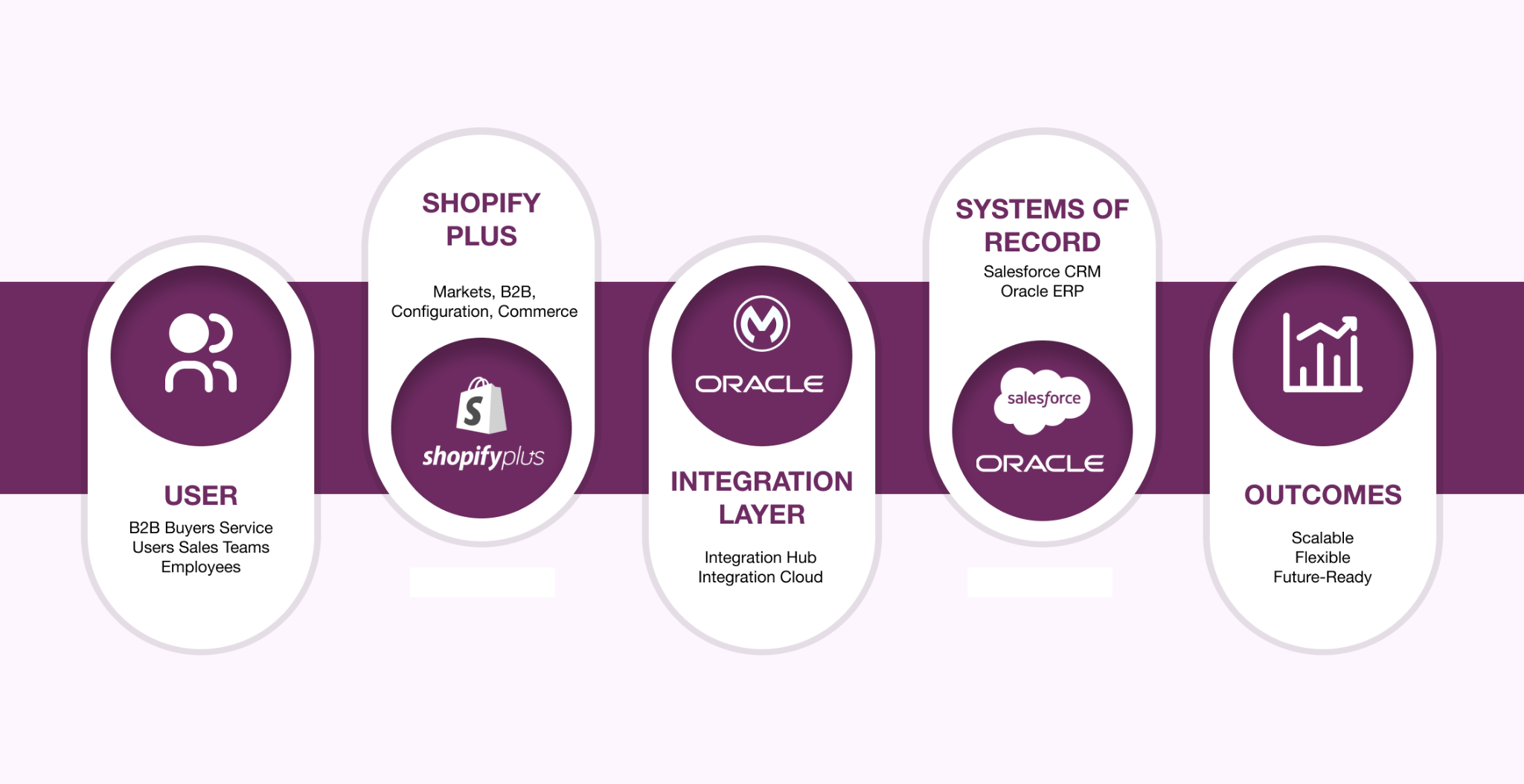
Shopify Markets was used to support region-specific pricing, currency, tax handling, and localized storefront experiences across the initial launch markets. Shopify B2B capabilities were used to model company profiles, assign catalogs and price lists, define payment terms, and manage role-based user access. This made it possible to support external buyers, customer service users, internal sales teams, and employee demo-order workflows within one centralized platform.
The architecture deliberately favored configuration-driven behavior over rigid customization. Metafields were used to support region-specific product attributes, business rules, fulfillment notes, and segmentation logic. Shopify APIs exposed the key product, customer, order, and inventory objects required for real-time and near-real-time synchronization. Checkout extensibility was used where needed to support tailored B2B workflows and product-dependent information capture.
This design gave Candela a unified operating model without sacrificing the flexibility needed for market-specific execution. It also created a more future-ready architecture that could scale into additional markets, more distributor accounts, and more advanced use cases without forcing the business to redesign its core commerce workflows.
Key Technical Components
A critical part of the implementation was the bi-directional integration model. Company entities and users from Salesforce CRM were synchronized into Shopify as B2B companies and buyers. Orders placed in Shopify were exported into Oracle ERP using structured workflows, while inventory and fulfillment updates flowed back to Shopify to keep the storefront current. Key interactions such as account activity and order events were logged into Salesforce to maintain account context for sales and service teams.
The solution also included several custom business controls that mattered operationally. Checkout was enhanced with conditional questions based on the products in the cart so Candela could capture information needed for processing and shipping. A support banner was added to guide customers when assistance was required. Purchase eligibility logic ensured customers could order related parts and accessories only when they had previously purchased the relevant machine, which helped preserve important business restrictions in the new platform.
Security, Compliance, and Governance
The platform was designed to meet enterprise expectations for security, governance, and operational control. All API interactions were secured through OAuth2 or token-based authentication, and role-based access control was applied across Shopify admin and the integration platforms. Separate development, staging, and production environments were used to support safer testing and controlled releases.
Payments remained within Shopify’s PCI-compliant infrastructure or approved payment gateways, reducing compliance burden for the commerce layer. Customer data was designed to move only through approved secure channels, with no unnecessary storage of personally identifiable information outside designated systems. Integration workflows were built with traceability in mind so technical teams could track data movement across Shopify, Oracle, Salesforce, and Vertex.
From a governance perspective, the implementation aligned with enterprise expectations around auditability, access control, and maintainability. It also supported Candela’s broader international operating model by creating a structured base for localization, tax handling, and account governance across regions.
Implementation Methodology
The project followed a lightweight Agile framework designed for integration-heavy Shopify Plus programs. Work was organized into manageable units aligned with business objectives and delivered incrementally to allow rapid feedback, earlier validation, and better coordination across stakeholders. Two-week sprint cycles provided cadence, while weekly status calls and decision logs kept priorities visible and dependencies manageable.
The implementation was structured into sequential but partially parallel workstreams. Discovery and technical planning established the architecture, integration model, and scope boundaries. Shopify Plus environment setup configured the platform, markets, permissions, and supporting environments. B2B configuration established company entities, catalogs, pricing logic, and payment terms. Data migration workstreams handled the cleansing, mapping, importing, and validation of legacy Salesforce Commerce Cloud records.
System integration workstreams connected Shopify with Oracle ERP, Salesforce CRM, and Vertex using OIC and MuleSoft. Theme adaptation aligned the selected theme with B2B workflows and back-end data structures. Testing and QA validated storefront experience, integration reliability, business logic, and operational workflows. Launch support then covered cutover planning, final production migration, and immediate post-launch monitoring.
Although the overall delivery spanned five months from planning to launch, the formal implementation plan was executed through a 10-week core delivery framework with clearly defined milestones. That combination of broader program management and focused execution helped balance enterprise coordination with delivery speed.
Quantified Business Results
While the project documentation did not include a complete set of official post-launch performance metrics, the operating model and implementation design support a clear set of conservative benchmark outcomes commonly associated with comparable enterprise Salesforce Commerce Cloud to Shopify Plus B2B transformations. These benchmarks are useful because they help executive stakeholders evaluate the commercial value of consolidation even when client-specific metrics are still being accumulated.
From a strategic standpoint, the most important gain is not just cost reduction. The deeper advantage is the creation of a platform that makes growth easier to execute. Candela now has a commerce model designed around central governance, market flexibility, and reusable system patterns. That is what enables more confident international rollout, more consistent buyer experiences, and lower friction between commerce, sales, operations, and support teams.
International Expansion Readiness
A central objective of the program was to create a future-ready foundation for global growth. The Shopify Plus architecture was intentionally structured to support expansion into additional markets based on revenue recognition models, legal entity requirements, payment gateway availability, and local tax obligations. This makes the platform relevant not only for current operations, but also for Candela’s next stage of international commerce development.
For supported countries that can operate through Shopify Payments and recognized regional entities, new markets can be enabled within the main Shopify Plus store using Shopify Markets. This approach preserves a unified admin environment, shared integrations, and lower operational overhead. For unsupported regions that require local payment gateways or separate commercial structures, the architecture also supports add-on stores as a future option.
This distinction matters because it gives Candela an economically rational path to global rollout. Supported markets can be launched more efficiently inside the primary platform, while unsupported markets can be scoped as dedicated store expansions when local regulatory or payment requirements demand it. That planning logic reduces future ambiguity and turns international scaling into a repeatable operating model instead of a custom project each time a new region is added.
Strategic Best Practices and Executive Takeaways
Candela’s transformation offers several lessons for enterprise B2B commerce leaders. First, storefront consolidation only creates lasting value when it is paired with strong systems integration and disciplined business-rule migration. Replatforming alone does not solve fragmentation unless the underlying data flows, governance model, and account logic are also modernized.
Second, native platform capabilities should be used wherever possible. Shopify Plus B2B and Markets provided the structural capabilities Candela needed to reduce customization burden while preserving region-specific business requirements. That lowered future maintenance risk and made the platform easier to evolve.
Third, complex B2B programs should be treated as operational transformation initiatives, not only website projects. Candela’s solution touched pricing, tax, inventory, account structures, internal sales workflows, distributor enablement, and global expansion planning. The business value came from how these elements were orchestrated together, not from any one feature in isolation.
The initiative also reinforces a practical framework for evaluating similar enterprise transformations:
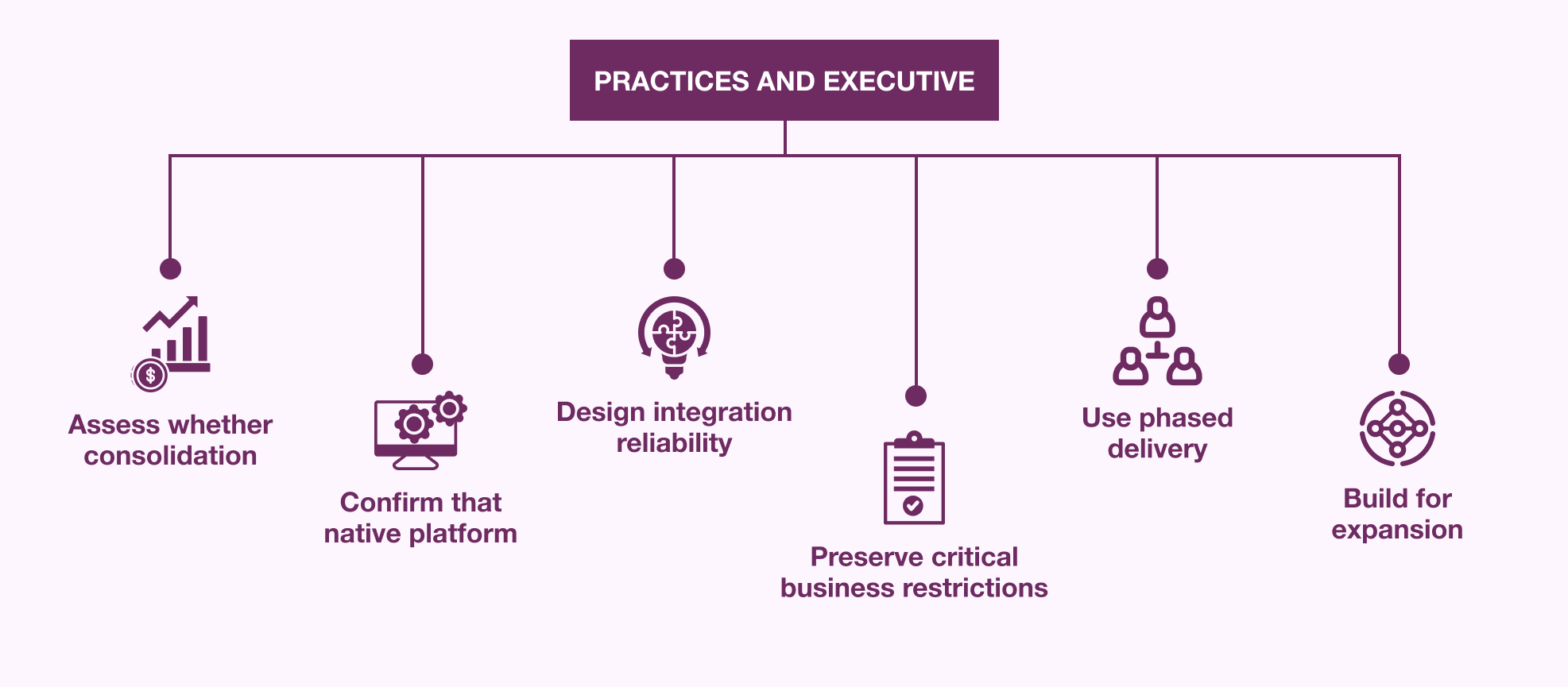
- Assess whether consolidation will materially reduce duplicated cost and administrative overhead.
- Confirm that native platform features can support the target B2B operating model.
- Design integration reliability, logging, and traceability early rather than treating them as secondary concerns.
- Preserve critical business restrictions such as account rules, eligibility logic, and operational data capture during migration.
- Use phased delivery to lower launch risk and create cleaner stakeholder alignment.
- Build for expansion from the start so new markets can be activated without redesigning the architecture.
Conclusion
Candela Medical’s Salesforce Commerce Cloud to Shopify Plus transformation created a centralized B2B commerce platform that is more scalable, easier to manage, and better aligned with global growth. By consolidating four regional storefronts into a single Shopify Plus instance, integrating Salesforce CRM, Oracle ERP, and Vertex through MuleSoft and OIC, and preserving essential business logic across pricing, checkout, shipping, and eligibility, the project delivered both immediate operational improvement and long-term strategic value.
The most important outcome is that Candela now has a platform designed for execution at scale. It can support localized experiences, account-specific commerce, internal workflows, and future distributor expansion without recreating the fragmentation of the legacy model. For enterprise organizations facing similar challenges, this case demonstrates how a carefully structured Shopify Plus implementation can improve cost structure, accelerate delivery, and create a more resilient global commerce foundation.
MLVeda helps enterprises modernize commerce infrastructure, integrate complex system landscapes, and build scalable B2B experiences on Shopify Plus. Organizations exploring similar transformations can learn more at MLVeda.
We’re Listening
Whether you're exploring strategic transformation opportunities or seeking a partner to architect and execute enterprise technology initiatives, we're here to help. Reach out to our team at services@mlveda.com or complete the form to begin the conversation.

